Home Insurance in Poland • Apartment & Tenant Cover from 150 zł a Year for Foreigners
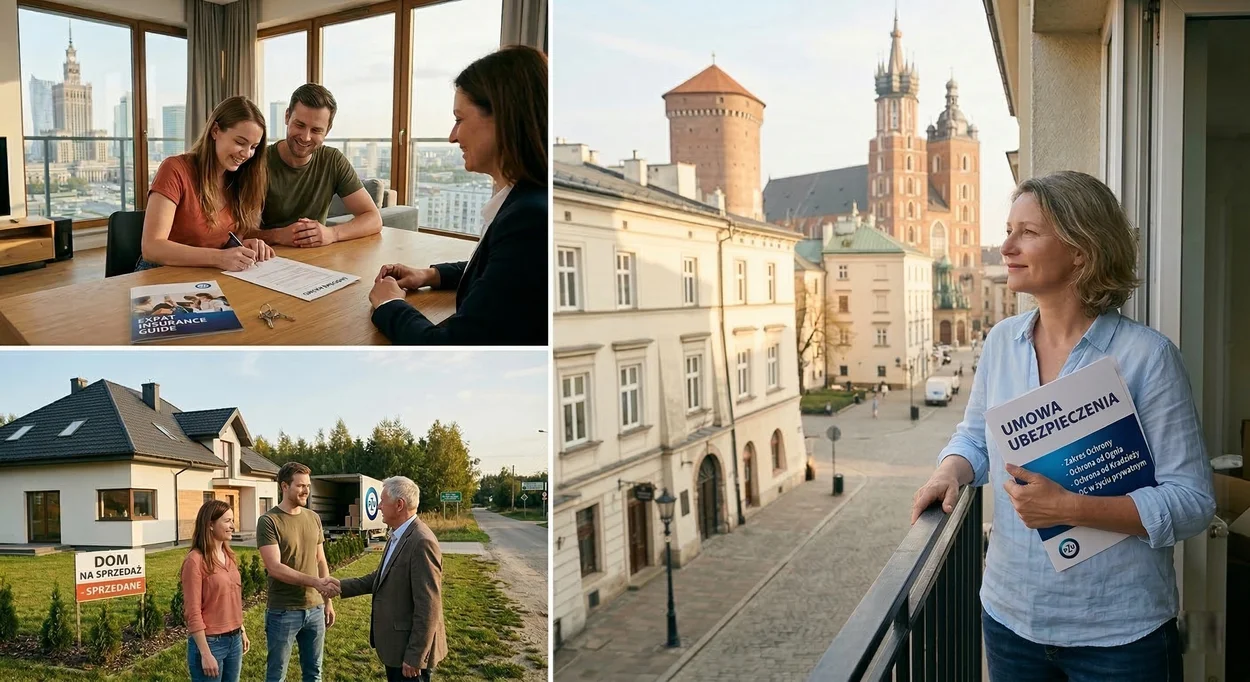
Home insurance in Poland costs roughly 150–800 zł per year — about 150–400 zł for a tenant's policy on a typical apartment, 300–1,200 zł for an owner's apartment policy, and 400–2,500 zł for a house. For almost everyone it is voluntary, with two exceptions: farm buildings (required by law) and mortgaged property (required by your bank, via a cesja — assignment of policy rights). If you're an expat renting or buying here, that's the short answer. Below: exact prices by flat size, who insures what between tenant and landlord, what the bank demands on a mortgage, and the mistakes that cost people the most.
The 30-second version:
- Renting? You need contents insurance (ruchomości domowe) + private liability (OC w życiu prywatnym). From about 150 zł/year. Your landlord's policy does not cover your belongings.
- Own it outright? Insure walls (mury), fixed elements (elementy stałe), contents and liability. 300–1,200 zł/year for a flat.
- Have a Polish mortgage? Insurance is effectively mandatory, must cover the structure at rebuild value, and the bank must be named through a cesja.
- Is it required by law? No — except farm buildings under the Act on Compulsory Insurance.
You've signed a lease in Warsaw, bought a flat in Kraków, or maybe you're closing on a house near Łódź. Whatever your situation, there's one question that comes up sooner than most expats expect: how do I insure my home in Poland?
The good news is that foreigners in Poland have full access to the same property insurance products as Polish citizens. The not-so-good news is that navigating the system — with Polish-language policy documents, unfamiliar terminology, and a different insurance culture — can be genuinely confusing. This guide breaks it all down. You can also see our Polish-language home and apartment insurance page for scope and pricing details.
Is Home Insurance Mandatory in Poland?
No — for private apartments and houses, home insurance in Poland is voluntary. There is no statutory obligation for apartment owners or tenants to carry property insurance. There are two exceptions:
- Agricultural properties: If you own a working farm (gospodarstwo rolne), you're legally required to insure the buildings on the property. This is regulated under the Act on Compulsory Insurance (Ustawa o ubezpieczeniach obowiązkowych).
- Mortgaged properties: If you finance your purchase with a Polish mortgage (kredyt hipoteczny), the bank will require property insurance for the entire life of the loan. It isn't statutory law, but it is effectively mandatory — no policy, no disbursement.
For everyone else — renters, outright owners, investors — insurance is optional. But "optional" doesn't mean "unnecessary." A single water damage incident in a Polish apartment block can easily generate 30,000–50,000 zł in liability, and without insurance, that's entirely your problem.
Mortgage and cesja — what the bank actually requires
Cesja praw z polisy means assignment of the rights to the insurance payout to your bank. In practice, the bank becomes the beneficiary of the structural part of the policy up to the value of the outstanding loan. What Polish banks typically demand:
- Cover for the structure (mury for a flat, mury i elementy stałe for a house) at least at the outstanding loan amount — most banks prefer full rebuild (replacement) value.
- Named perils including fire and other natural forces (ogień i inne zdarzenia losowe) as a minimum scope.
- A cesja clause or separate cesja document issued by the insurer and delivered to the bank, usually within a set deadline after each renewal.
- Annual renewal proof. If the policy lapses, the bank may buy cover for you at its own (usually higher) price and add it to your instalment.
Practical tip: you are not obliged to buy the bank's own bundled policy. You can buy from any insurer as long as the scope, sum insured and cesja meet the bank's written requirements — and independently bought policies are frequently 200–500 zł/year cheaper for identical cover.
Key Polish Insurance Terms — Definitions
- Ubezpieczenie mieszkania / domu — apartment / house insurance; the property policy itself.
- Mury — the building fabric: walls, roof, floors, fixed installations. Insured by the owner, not the tenant.
- Elementy stałe — fixed finishing elements: kitchen units, tiles, built-in wardrobes, flooring, sanitary ware. In Poland this is a separate category from both walls and contents.
- Ruchomości domowe — movable contents: furniture, electronics, clothing, appliances. The core cover for tenants.
- OC w życiu prywatnym — private-life third-party liability; pays for damage you accidentally cause to other people or their property.
- Suma ubezpieczenia — sum insured; the maximum the insurer will pay.
- Franszyza / udział własny — deductible; the part of each claim you carry yourself.
- Wartość odtworzeniowa — replacement value (cost of rebuilding or buying new). Wartość rzeczywista — actual value, i.e. replacement cost minus depreciation. Always choose replacement value where available.
- OWU — Ogólne Warunki Ubezpieczenia, the General Terms and Conditions: 30–50 pages that decide what is really covered.
- Cesja — assignment of policy rights, typically to a mortgage bank.
- Zalanie — water damage/flooding from installations, the single most common Polish apartment claim.
Types of Home Insurance Available in Poland
Polish insurers typically offer property policies with modular coverage. You choose what you need (and what you can afford). Here's how the main components break down:
1. Ubezpieczenie mienia (Property / Contents Insurance)
This covers physical damage to your belongings and/or the structure itself. Depending on the policy, it may include mury (structure — relevant if you own), ruchomości domowe (contents — the core cover for renters) and stałe elementy wykończeniowe (fixed finishing elements).
Named perils typically include fire (pożar), flooding (zalanie), storm damage (huragan), burglary (kradzież z włamaniem), and vandalism. Some policies offer all-risk coverage, though these come at a premium.
2. OC w życiu prywatnym (Third-Party Liability in Private Life)
This is arguably the most important coverage for expats — and the one most often overlooked. OC w życiu prywatnym covers your civil liability for damage you accidentally cause to other people or their property in everyday life.
Classic scenario: your washing machine hose bursts while you're at work, water floods your apartment and the two apartments below. Without OC w życiu prywatnym, you personally pay for all the damage to your neighbors' property. With it, your insurer handles the claims.
This coverage typically costs between 50–150 zł per year for sums insured of 50,000–200,000 zł. For the price of a decent dinner, you're protected against potentially ruinous liability. Every expat living in a Polish apartment block should have this — full stop.
3. Assistance domowy (Home Assistance)
Many Polish property policies include or offer as an add-on a home assistance package: locksmith (ślusarz) if you're locked out, emergency plumber (hydraulik) for burst pipes, electrician (elektryk) for power failures, and temporary accommodation if your home becomes uninhabitable.
For foreigners who may not have a network of trusted Polish tradespeople on speed dial, home assistance can be genuinely valuable — not just financially, but practically.
Owner vs. Tenant — Who Insures What?
This is where things get confusing for expats. The short rule: the landlord insures the flat, the tenant insures their own things and their own liability. Neither policy replaces the other.
| Element | Landlord / owner insures | Tenant insures |
|---|---|---|
| Walls, roof, installations (mury) | Yes — and the bank requires it if mortgaged | No |
| Fixed elements (kitchen, tiles, flooring) | Usually yes, if they belong to the flat | Only fittings the tenant paid for |
| Your furniture, laptop, clothes, bike | No | Yes — ruchomości domowe |
| Damage you cause to neighbours (zalanie) | No | Yes — OC w życiu prywatnym |
| Damage you cause to the rented flat itself | Landlord claims from you or your deposit | Yes — OC w życiu prywatnym (najem clause) |
| Loss of rental income | Optional add-on for owner | No |
A practical tip: check your rental agreement (umowa najmu). Some Polish landlords include a clause requiring the tenant to carry liability insurance. Even if yours doesn't, get it anyway. The cost is negligible and the protection is significant.
How Much Does Home Insurance Cost in Poland? Prices by Flat Size
Property insurance in Poland remains relatively affordable compared to Western Europe. The cheapest apartment policies start around 100–150 zł/year; full packages with add-ons run higher. The table below shows realistic 2026 annual premiums by flat size — tenant version (contents + liability) and owner version (walls + fixed elements + contents + liability).
| Property size | Typical contents sum insured | Tenant policy (contents + OC) | Owner policy (mury + elementy stałe + contents + OC) |
|---|---|---|---|
| Studio / kawalerka, up to 30 m² | 20,000–30,000 zł | 150–220 zł/year (13–18 zł/month) | 250–400 zł/year |
| 2 rooms, 35–50 m² | 30,000–50,000 zł | 180–280 zł/year | 320–550 zł/year |
| 3 rooms, 50–70 m² | 50,000–70,000 zł | 250–350 zł/year | 400–700 zł/year |
| 4 rooms, 70–90 m² | 70,000–100,000 zł | 300–420 zł/year | 500–900 zł/year |
| Large apartment, 90–120 m² | 100,000–150,000 zł | 380–500 zł/year | 700–1,200 zł/year |
| House, 120–160 m² (dom jednorodzinny) | 100,000–200,000 zł | — | 400–1,500 zł/year (up to 2,500 zł with garage, outbuildings, PV panels) |
For reference, a full package including photovoltaics for a 120 m² house typically lands around 400–800 zł. Factors that move the price: property location and flood risk zone, construction year and materials, sum insured, selected perils and scope, deductible (franszyza), and security measures such as alarms or reinforced doors.
One useful benchmark: differences between insurers for an identical scope of coverage can reach 300–500 zł per year — which is exactly why comparing offers matters. If you're curious about how comparison tools work, see our guide on how insurance comparison websites work and what to watch out for.
Major Insurers Offering Home Insurance in Poland
Poland has a competitive property insurance market. The table below summarises the main players you'll encounter and what each is known for:
| Insurer | Flagship product | Known for |
|---|---|---|
| PZU | PZU Dom | Largest Polish insurer; broadest agent network and nationwide reach |
| Ergo Hestia | ERGO 7 | Strong in property insurance; flexible, modular packages |
| UNIQA | UNIQA Dom | Competitive pricing and good digital/self-service tools |
| Generali | Generali, z myślą o domu | Established European insurer with solid all-round property cover |
| Allianz | Allianz Dom | Premium positioning; comprehensive, wide-scope coverage |
| TUZ Ubezpieczenia | TUZ Dom | Budget-oriented, basic property coverage |
| Wiener (formerly InterRisk) | Wiener Dom | Popular in the mortgage insurance segment |
Each insurer has different OWU, different exclusion lists, and different claim handling processes. This is exactly why comparing policies on price alone is unreliable. A 200 zł policy that excludes water damage from a defective installation is not cheaper than a 350 zł policy that covers it — it's just worse.
Can Foreigners Buy Property Insurance Without Problems?
Yes. Polish insurers do not restrict property insurance based on nationality. If you legally reside in Poland — whether on a visa, Karta Pobytu (residence card), EU registration, or Polish citizenship — you can purchase home insurance on exactly the same terms as a Polish citizen.
What you'll need:
- PESEL number — most insurers require this for policy issuance. If you're registered in Poland, you should already have one.
- Property address — the exact address of the insured property, which must be a Polish address.
- Ownership or rental documentation — not always required at purchase, but useful and sometimes necessary for claims.
- Property details — construction year, area (m²), construction type, number of floors.
The real challenge isn't eligibility — it's language. OWU documents routinely run 30–50 pages of dense legal Polish, and policy certificates, claim forms and insurer correspondence are almost exclusively in Polish. This is where working with an agent who speaks your language makes a practical difference. If you're new to the Polish insurance system generally, our overview of how insurance works in Poland covers the regulatory basics, including KNF and your rights.
Moving In With a Car? What Changes for Motor Insurance
Most expats who insure a home in Poland also bring or buy a vehicle, and here the rules are stricter than for property — motor third-party liability (OC) is compulsory, not optional. A few things surprise newcomers.
First, the PESEL issue cuts deeper than with home insurance: foreigners without a PESEL number receive significantly fewer offers, because insurers cannot retrieve their Polish insurance history and many simply decline to quote. To calculate an offer at all, the agent needs a photo of your passport or the national ID document of your country of citizenship, the vehicle purchase agreement, and a Polish address. The premium itself depends on a long list of factors — the owner's age, the address, the make, model and engine capacity of the car among them.
Second, timing. Contrary to what most wydział komunikacji (registration office) websites state, the vehicle does not have to be insured at the moment you file for registration — but it must be insured no later than the day of registration, before it is put into traffic. A vehicle should be insured in its country of registration, and if it has no valid policy, the UFG (Insurance Guarantee Fund) charges a penalty for every single day without cover. Our guides on mandatory OC insurance for foreigners, registering a car in Poland and OC penalties and fines cover this in detail.
Third, payment. OC is bought for a full year (instalments are possible), and payment is almost always made upfront by bank transfer to the insurer's account. If you're transferring from a foreign bank account, allow for the fact that it can take several days to arrive and budget for currency conversion costs. Crucially, the policy is issued only once the payment is credited to the bank account — sending a screenshot or confirmation of the transfer is not enough. Plan the transfer accordingly if you have a registration appointment booked. For the full walkthrough, see our guide to buying car insurance in Poland as a foreigner.
Common Mistakes Expats Make with Property Insurance
After 30+ years in the insurance business, we see the same errors repeatedly.
Underinsuring contents (niedoubezpieczenie)
People estimate their belongings at 20,000 zł when the actual replacement cost is 60,000 zł. If you're underinsured and make a claim, the insurer can apply a proportional reduction (zasada proporcji). You insured 33% of the real value? You get 33% of the payout. Walk through your apartment and actually add up what it would cost to replace everything. You'll be surprised.
Skipping OC w życiu prywatnym
This is the single most cost-effective insurance product available in Poland. A zalanie claim can easily reach 30,000–50,000 zł. Your annual premium is probably 50–80 zł.
Letting the mortgage policy lapse
Banks track renewal dates. Miss one and the bank can insure the property itself at a higher premium and charge it to you — or, in the worst case, treat it as a breach of the loan agreement. Set a reminder, and remember the cesja document has to be re-issued at each renewal.
Not reading the exclusions
Every Polish property policy has exclusions (wyłączenia odpowiedzialności). Common ones: damage caused by gradual moisture or mould, damage from poor maintenance, theft without signs of forced entry (kradzież bez włamania), and damage during renovation work. Know what's excluded before you need to claim.
Assuming the landlord's insurance covers you
It doesn't. The landlord's policy protects the landlord's property and the landlord's liability. Your laptop, your furniture, and the damage your overflowing bathtub causes — that's on you.
What to Do When You Need to File a Claim
- Document the damage immediately — photos and video, with timestamps. Photograph everything before cleaning up.
- Report to the insurer — by phone, online portal, or through your agent. The deadline is usually 3–7 days, but sooner is always better.
- File a police report (zgłoszenie na policję) — mandatory for burglary and vandalism claims.
- Preserve damaged items — don't throw anything away until the insurer or their adjuster (rzeczoznawca) has inspected it.
- Keep receipts — for emergency repairs, temporary accommodation, and any expenses related to the incident.
The insurer has 30 days from the date of claim notification to issue a decision, though complex cases can take longer. If you disagree with the settlement, you have the right to appeal — first internally, then through the Financial Ombudsman (Rzecznik Finansowy) if necessary.
A Note on Insurance for Investment Properties
If you own a property in Poland that you rent out — whether long-term or through platforms like Airbnb or Booking.com — make sure your insurance reflects this. A standard home policy typically assumes owner-occupation. Renting the property out, especially short-term, may void your coverage if not properly disclosed.
You'll need a policy that covers wynajem (rental) and, for short-term rentals, potentially a commercial or business insurance policy. This is a conversation worth having with your agent before your first guest arrives.
Frequently Asked Questions: Home Insurance in Poland
Is home insurance mandatory in Poland?
No. For private flats and houses it is voluntary — there is no legal obligation for owners or tenants. Two exceptions: buildings on a working farm must be insured under the Act on Compulsory Insurance, and if you have a Polish mortgage the bank contractually requires property insurance with a cesja for the life of the loan.
How much does home insurance cost in Poland?
A basic apartment policy starts around 100–150 zł per year. A tenant's package (contents + OC) runs 150–400 zł, an owner's apartment policy 300–1,200 zł, and a house 400–2,500 zł per year. A 50 m² flat typically costs 180–280 zł as a tenant policy and 320–550 zł as an owner policy.
How much does tenant / renter's insurance cost in Poland?
A basic tenant's policy (contents insured at 20,000 zł + OC at 50,000 zł) starts at about 150–200 zł per year — roughly 13–17 zł per month. A standard package (50,000 zł contents + 100,000 zł OC + home assistance) is 250–350 zł/year, and a comprehensive one (80,000 zł contents + 200,000 zł OC + burglary) 350–450 zł/year. Even the top tier is usually under 40 zł/month.
What is a cesja and why does my bank want one?
Cesja praw z polisy is the assignment of the insurance payout rights to your mortgage bank, up to the outstanding loan balance. It ensures the bank is repaid if the property burns down or is destroyed. You must supply the cesja document at every renewal — and you are free to buy the policy from any insurer, not only the one the bank offers, provided the scope and sum insured meet its written requirements.
Does my landlord's insurance cover my belongings?
No. A landlord's policy covers the landlord's structure and liability — not your personal belongings and not your liability. As a tenant you need your own contents insurance (ruchomości domowe) and OC w życiu prywatnym for damage you might cause to the flat or to neighbours.
Can a foreigner buy home insurance in Poland?
Yes. Insurers don't restrict property insurance by nationality. If you legally reside in Poland (visa, Karta Pobytu, EU registration, or citizenship) you buy on the same terms as a Polish citizen. You'll generally need a PESEL number, a Polish address for the property, and basic property details. Note that for motor insurance the lack of a PESEL is a bigger obstacle — foreigners without one receive significantly fewer offers, because their Polish insurance history cannot be retrieved.
What is OC w życiu prywatnym and do I need it?
It's private-life third-party liability cover — it pays for damage you accidentally cause to other people or their property, such as a burst hose flooding the apartments below you. At roughly 50–150 zł per year it's the single most cost-effective protection available, and every expat in an apartment block should have it.
What happens if I cause water damage to my neighbour's apartment?
You are personally liable for the full cost of repairs — a typical zalanie case runs 15,000–50,000 zł depending on severity. With OC w życiu prywatnym, your insurer pays the claim on your behalf. Without it, you pay out of pocket.
Do I need home insurance to get a visa or Karta Pobytu?
No. Property insurance is not required for Polish visa or residence permit applications. However, you will typically need health insurance — a separate product. Don't confuse the two.
Can I buy home insurance in Poland without speaking Polish?
Technically yes — some insurers sell online in Polish only and you could use translation tools. Practically, we strongly recommend an English-speaking agent. OWU documents are 30–50 pages of dense legal Polish, and misunderstanding one exclusion can cost you thousands at claim time. Magro provides full English-language consultation and handles the paperwork.
How long does an insurer have to settle a claim?
Polish insurers have 30 days from claim notification to issue a decision, though complex cases can take longer. If you disagree with the outcome, you can appeal internally and then escalate to the Financial Ombudsman (Rzecznik Finansowy).
Why Work with Magro on Your Property Insurance?
Magro Ubezpieczenia has been advising clients in Łódź and across Poland for over 30 years. As a multi-insurer agency, we work with all major Polish insurers — PZU, Ergo Hestia, UNIQA, Generali, Allianz, Wiener, and others — which means we compare products on your behalf and recommend what actually fits your situation.
For expats and foreign property owners, we offer:
- English-language consultation — we explain Polish policy terms, coverage options, and exclusions in plain English.
- Multi-insurer comparison — we don't sell one company's products; we find the best fit from the full market.
- Mortgage and cesja handling — we prepare cover that meets your bank's requirements and issue the cesja documents.
- Claim support — when something goes wrong, we help you navigate the process with the insurer.
- Ongoing policy management — renewals, adjustments, and coverage reviews as your situation changes.
Whether you're renting a studio in Łódź or buying a family home in the suburbs, proper protection starts with understanding what you actually need. That's what we're here for — and if you're also settling a car, a health policy or a business here, we can handle the full picture.
Ready to insure your home in Poland? Get a free quote from Magro Ubezpieczenia — we'll review your situation and find the right coverage at the right price, with full English-language support and zero guesswork.